
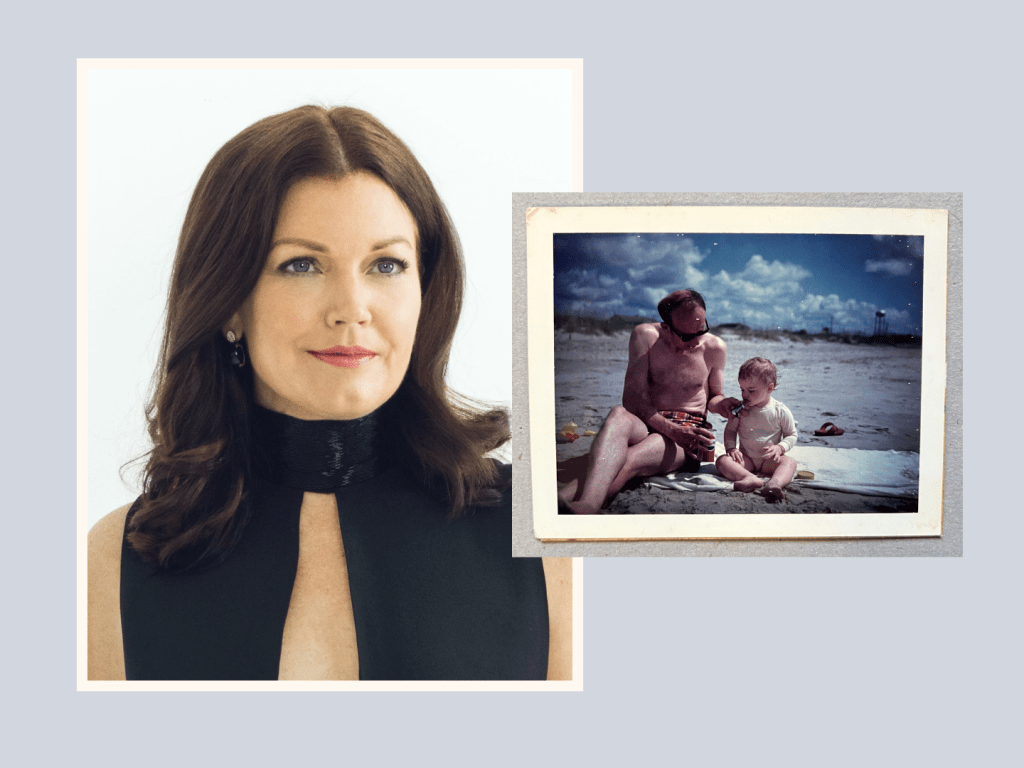
I was always a daddy’s girl. My mother, a teacher, had the most incredible mind of anyone I’ve ever known, but she was a complicated person. My dad, though, was the center of my world.
It was always just us three. I was the child they’d always wanted and fought to have by adopting me as an infant after a years-long fertility battle, including seven miscarriages. That made us, for better or worse, a pretty tight unit.
My dad taught me how to throw a softball, and we’d listen to bluegrass music together. He was a state auditor in the 70s, so sometimes I’d ride around North Carolina with him while he worked, beaming with pride at his ability to make friends (and make time for a drink with those friends) wherever he went.
He was my superhero until he quickly became not that guy anymore.

Courtesy of Bellamy Young
I was 13 when he was initially diagnosed with cirrhosis, a complication caused by long-term liver damage. We blamed his drinking and, as a family, did our best to shut the door so no one would see this private shame. It felt embarrassing, like my father had failed in some way and this diagnosis was his punishment.
As I carried what then felt like my family’s indignity, a frustration emerged inside me for this man I once considered my hero. He became combative, and I, still a teenager, was my worst self in return. I’d smell his breath and conclude that he was drinking during the day, I’d roll my eyes when he forgot to pick me up from school and I’d get frustrated by his flapping hands, chalking it all up to alcoholism.
I judged him and it remains one of the few big regrets of my life.
The realization that these behaviors were actually symptoms of something bigger came fast and furious. For 20 years, my father traveled to the same building for work with no issues until one night, he couldn’t find his way home. We feared something else entirely was wrong with him: we could never have imagined that what we were seeing was a result of a progressive liver disease. So, we returned to the doctor only to come away with an overt hepatic encephalopathy (HE) diagnosis.
It’s still a mouthful for me to say now, even after years of work advocating for caregivers and those living with the disease. So if anybody needs to hear, overt just means not hidden, hepatic means related to the liver and encephalopathy means something that affects your brain.
Armed with minimal information, it never crossed our minds that a disease that started in my dad’s liver could cause changes in his personality, his proprioception, or his day-to-day life.
Treatment, if you could even call it that, for HE at the time was like the wild west (though that has changed now, and there are treatment options that I encourage anyone with an OHE diagnosis to discuss with their doctor). Trips to hospitals and doctors brought no answers, and soon, my dad was spending most of his days on a hospital bed in our music room. With that came a dawning feeling that I was losing my dad even though he was still there.
All the while, the teenage years I imagined for myself fell from view. You can’t have friends over when someone is dying in your home. Dumb dance competitions and scholarships mean very little when after-school hours are spent caring for your dad’s basic needs. And in moments when you manage to scrape together some joy amid such existential sadness, it feels inappropriate to bring it home. There’s no room for it.
Courtesy of Bellamy Young
Just two short years after his initial cirrhosis diagnosis, my dad passed away from another illness. In some ways, it felt like it happened all at once; in other ways, I had been grieving him since the moment he stopped being himself.
In any case, he suddenly wasn’t there. The hospital bed in the living room, all the pills, the hospice workers and the IV lines. All of that was suddenly gone.
They say the quickest way to deal with something is to go through it, but I went around my pain, pushing it to the side while I took on my dad’s duties in the house. I learned to write checks and pay our bills until eventually I left for Yale.
Over time, the shame I felt around my dad’s death turned into guilt. My dad’s cirrhosis diagnosis and later his overt hepatic encephalopathy initially felt to me like a failure of will. He was an alcoholic, that much I can acknowledge. But I regret the time I spent blaming him for a condition that can occur for so many different reasons, and I feel guilty for not advocating for him better, regardless of the how or the why of the disease.
That guilt lives inside me like an itch I can’t scratch.
So, when the opportunity arose to raise awareness for HE and for those caring for a person with HE, I was grateful to have a way both to atone for my behavior while my dad was sick, but also to make sure that no one ever felt alone or uninformed as they walked the OHE path. Through a partnership with Salix Pharmaceuticals and my Instagram series Caregiver Conversations, I’ve connected with HE patients and caregivers to break stigmas, share our stories, and offer support.
It’s always painful to talk about. There will always be the stomach knots and sweat as I talk about it, but the pain has eased over the years and if I can help one person not feel the way I did, then all the pain is more than worth it.